The ask
Full post on a 16 to 22 minute adventure documentary.
- Picture edit, sound design, music, color, finish.
- We hand over the raw. You deliver the film.
- Live editing during the expedition, September 4 to 12.
- One film. Delivery on or about October 24.
What this is
Not a normal expedition film.
- Between 35,000 and 50,000 people climb Kilimanjaro every year. Almost all of them go up the same handful of south-side routes and stand on the same crater rim at sunrise.
- One side of the mountain has no commercial traffic at all.
- Over six visits across several years, Jim Thompson kept asking the Tanzanian park authority and his guides whether a route could be opened on that empty western side.
- The park service flew the line from the air. The guides walked the pieces and stitched them together.
- In September we climb it and film it.
Nobody has made a film on this route, because until last year nobody had walked it.
The route
Up the west side, across the icefield, out by air.
- Helicopter in. Two aircraft to a farm on the west side, so one can film the other.
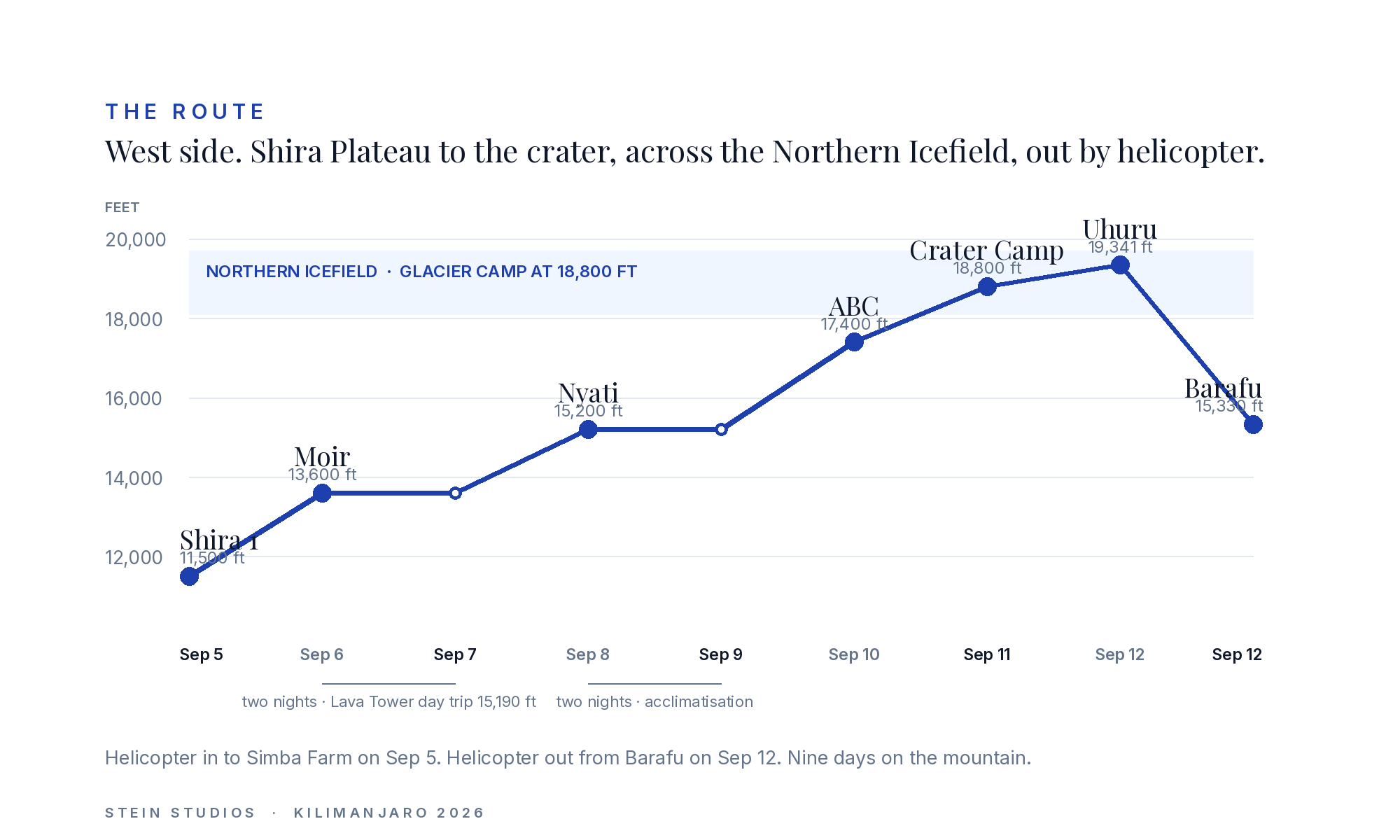
- Nine days up. Shira Plateau at 11,500 feet to Crater Camp at 18,800.
- A night inside the crater, between glacier walls seventy metres high.
- The Northern Icefield crossed before dawn, under a new moon, on headlamps.
- Uhuru at 19,341 feet, then down the far side and out by helicopter. We do not walk down.
The Reusch Ash Pit sits inside the crater: a near-perfect 140-metre circle with a floor still around 78°C. Snow melts on contact. The volcano is not extinct, it is sleeping.
Schedule
September 2026.
| Sep 3 | Arrive Kilimanjaro airport, 20:00. Night at Arusha Coffee Lodge. |
| Sep 4 | Gear check and acclimatisation day. Possible Rift Valley flight. |
| Sep 5 | Helicopter to Simba Farm, drive to the barrier, walk in to Shira 1. 11,500 ft. |
| Sep 6 | Shira 1 to Moir. 13,600 ft. |
| Sep 7 | Acclimatisation at Moir. Day trip to Lava Tower, 15,190 ft, and back. |
| Sep 8 | Moir to Nyati. 15,200 ft. |
| Sep 9 | Acclimatisation at Nyati. |
| Sep 10 | Nyati to Advanced Base Camp. 17,400 ft. |
| Sep 11 | ABC through the glaciers and the cinder cone to Crater Camp. 18,800 ft. |
| Sep 12 | Crater Camp across the icefield to Uhuru, 19,341 ft. Down to Barafu. Helicopter out. |
| Sep 13 to 16 | Rift Valley coverage and a village-run community camp. Departure Sep 16. |
The story
A man opens a way up, then gives it away.
On the empty western side of a suffering mountain, a Western explorer and a Chagga crew open a new way up, and hand it to the mountain's own people to name and to keep, while the 11,700-year-old summit ice disappears in a single climbing lifetime.
Two things run at once, and the edit treats them as a race.
Disappearing
The summit glacier. An 11,700-year climate archive, roughly 1 km² today, more than 90 percent gone since 1912.
Being built
The route becoming permanent, and one man becoming a guide, on camera, inside our shooting window.
The peak of the film is not the summit. It is the moment the guides name the route themselves, in Swahili, on camera. The summit comes after, and it is deliberately short.
Who is in it
The characters.
Jim · the explorer
71 years old, two decades at the edges of the map, and physically incapable of sitting still. He kept showing up until the route existed, then handed it over. He opens the film and closes it.
John · the guide arriving late
Near 40. Carried loads on this mountain for years, unseen. One night in a tent he finally said out loud that he wanted to be a guide. A Tanzanian mentor gave him terms rather than a favour: learn your English, pass the wilderness first responder course, then we talk. He did both. Most men do this at twenty. He did it late, and he did it himself. He guides a live section of the new route during our shoot. This is the heart of the film.
Jamal · the young one
A very young guide with better English than most of the crew, fast and light and delighted, who helped scout the line. Where John arrived late, Jamal is the reason the route exists at all. One day this mountain will be his to show the world.
The guides and locals · the chorus
A climbing park ranger who out-climbs the operator on his own mountain. Porters, cooks, camp crew. A former camp manager who now owns a shop with his wife. A village-run community camp in the Rift Valley. A large share of the film is carried from their perspective, in their own words, subtitled.
Jim's family · Jamie and Matty
Climbing with him. The next generation watching a man move through terrain he taught himself to read, at an age when most people have stopped. Their material runs through the film, not beside it.
Benjamin · the operator
Co-author of the route. He explains how the system works and, twice on record, points the camera away from himself and toward the crew. The film takes that instruction literally.
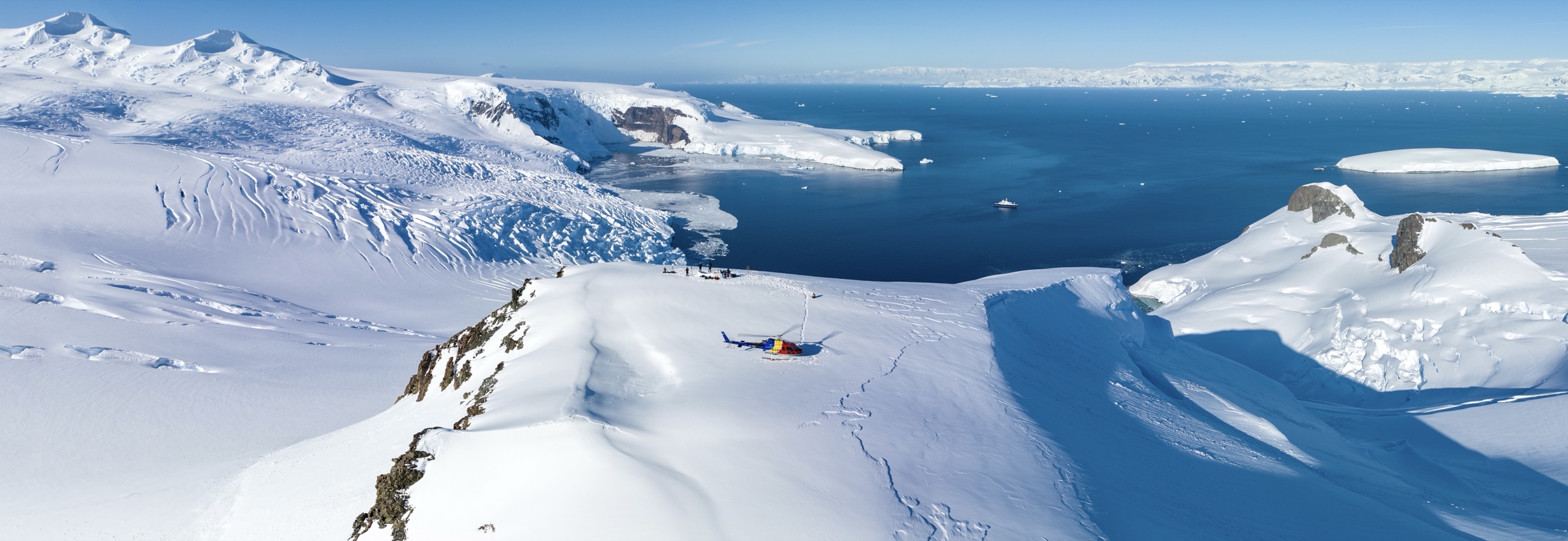
Tonal reference · Stein Studios archive. Kilimanjaro plates arrive September.
Why this one is unusual
Things you will not get on another job.
01 · A route being authored on camera
Not a retrace of somebody else's line. The rope is being fixed and the ground learned while we film it. The GPS points have never been published.
02 · A 137-year story that finally closes
In 1889 a German climbed Kilimanjaro and named the summit for his Kaiser. His Chagga guide, Yohani Kinyala Lauwo, knew the way and waited a century for credit. In 1961 a Tanzanian soldier climbed it in the dark and renamed it Uhuru, freedom. The guides on this route are of that same lineage. This time they name it while it is happening.
03 · The Tanzanian government is watching it
The park authority flew the recce and has staff on the expedition. A new route relieves pressure on an over-used mountain and moves work into an under-protected wildlife corridor. There is a real prospect of a version made for the government's own use.
04 · A leopard, a hemingway story, and a sleeping volcano
In 1926 a missionary found a frozen leopard on the western rim at 18,500 feet. Nobody could say what it was doing up there. That leopard opens The Snows of Kilimanjaro. We are camping in the crater it died above.
05 · Ice older than farming
The summit ice holds 11,700 years of tropical African climate, drilled to bedrock in 2000 and published in Science. It is more than 90 percent gone since 1912. A climber with a camera can now record the change across a single career.
06 · Three volcanoes, one mountain
Shira, Mawenzi and Kibo, fused across 2.5 million years. Shira collapsed and left a 13-kilometre plateau, which is where we start walking.
Style and tone
Open to your thoughts on this.
The films below are where we are looking for register. They are also enormous productions with full crews and years of access. This is one person with a camera. We are pointing at a feeling, not claiming to match them.
- Herzog. A narrator who is curious rather than heroic.
- Sherpa. A mountain told from the perspective of the people who carry it.
- 14 Peaks. Local climbers at the centre, not in the background.
- Meru, Free Solo. How a score carries tension without shouting.
Music and sound
- There is a score, and it matters. Music drives the emotion.
- Not wall-to-wall. It lifts where the story needs lift, and gets out of the way where the mountain is doing the work.
- Sound design carries as much as the score: wind at three altitudes, ice, breath, boots, real voices.
- Open to original composition. We want your view.
Deliverable
One film, plus a trailer.
- The film. 16 to 22 minutes.
- Trailer. 45 to 60 seconds.
The private story and the bigger story are the same film, woven in and out of each other. Jim and his family are in it. So are the guides, the route, and the conservation case. We are not making two versions.
Distribution is private. No broadcast plan and no commercial release. A film for one family, a version that may go to the Tanzanian park authority and government, and a permanent record of a route that did not exist before.
Workflow
Live editing during the expedition.
- DaVinci Resolve collaborative over cloud.
- Dailies go up from the field over Starlink. Your editor cuts against them in near real time.
- An assembly forms while the story is still resolving.
- You can tell us on day six that a shot is missing, while we can still go and get it.
- I have run this workflow myself on around sixteen shoots. I am not an expert in it, but I know how it usually goes and where it tends to break.
Before you say yes
The hard parts, stated up front.
None of these are dealbreakers. We would rather you know them now than meet them in week three.
One shooter
A single camera operator for the whole expedition. No second angle and no safety coverage. On the day the team splits, we follow the rope crew.
Power and bandwidth at altitude
Nine days above the last power source, on solar and battery. We have Starlink for uploads and we will push as much as we can each night, but expect proxies to arrive out of order and occasionally late.
Tanzanian film permit
A foreign production works to national Film Board rules, and the finished cut is cleared before it leaves the country. Our operator handles this and we expect it to be routine. Flagged only so it is not a surprise on the delivery schedule.
Some of the guides are still being confirmed
The naming is the film's peak and it is a real event we intend to witness, not stage. If it does not happen, the film has a written fallback and still works. Every fragile beat is laddered the same way. You will not be handed an unsolvable hole.
That is the whole picture, including the parts that are not tidy. If it is interesting to you, let's talk.
Stein
Stein Studios